Boot Sale Alchemy: Spotting Tabletop Treasure in a Sea of Tatt
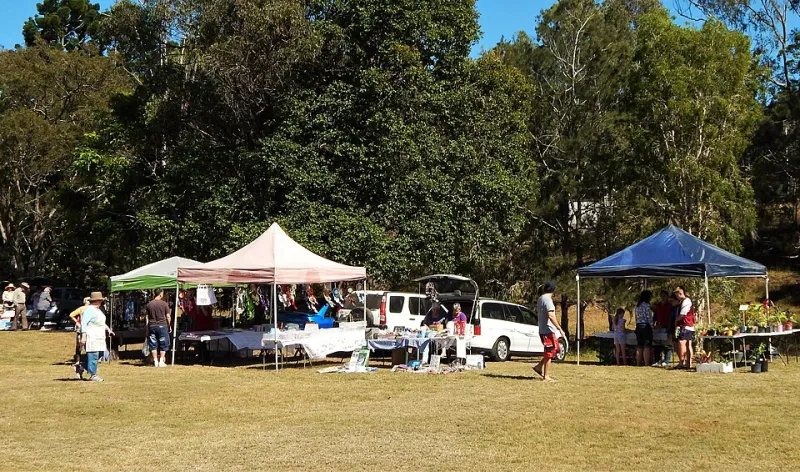
Photo: RegionalQueenslander, CC BY-SA 4.0, via Wikimedia Commons
It's ten to seven on a Sunday morning and I'm standing in a field in Leicestershire, nursing a tea that tastes faintly of thermos, watching a man unload a washing-up bowl of what turns out to be thirty-odd lead orcs. He wants three quid for the lot. I hand over a pound coin and a two-pound coin and walk away feeling like I've robbed a bank.
That was four years ago and I still haven't painted all of them. But that's rather the point, isn't it? Car boot season in the UK runs from roughly Easter to October, and tucked between the cracked DVD players and the boxes of mismatched cutlery there is a genuine, renewable supply of tabletop potential — if you know what you're looking at.
Why the boot sale still beats the auction site
Online marketplaces have made secondhand miniatures visible, which is both a blessing and a curse. Everyone can see what a sealed box is "worth", and everyone prices accordingly. A car boot sale is different. The seller is there to clear a garage, not to run a business. They've been up since five. They want the boot empty by eleven. That asymmetry is where the bargains live.
The trade-off is that you have to do the legwork, and you have to be willing to walk away empty-handed more Sundays than not. Think of it as a hobby within the hobby.
Know your scales before you leave the house
Before you go rummaging, fix in your head what you're actually hunting for. Most of us are 28mm heroic-scale gamers and painters, which sits alongside 25mm historicals, 15mm and 10mm mass-battle stuff, and the odd 1/72 or 1/56 vehicle. A box marked "28mm" in fading pencil could be anything, and old lead ranges often ran a head shorter than modern plastics.
Practical trick: keep a single based, primed figure in your pocket. Hold it against anything questionable and you'll know in two seconds whether the scale is workable. It also makes a decent conversation starter with the seller, which never hurts.
The five-second appraisal
Pick a model up. Turn it over. You're checking, in order:
- Material. Grey-white metal, chalky plastic, or the yellow-tan of polyurethane resin.
- Completeness. Is the arm attached? Is the sword still there? Old metal miniatures were often multi-part, and the parts went missing in 1989.
- Assembly quality. Thick glue blobs, melted joints and leaning torsos are all fixable, but they cost you time.
- Paint. A single thick coat of gloss enamel is a nuisance. Six layers of it is a weekend project.
If it passes those four, it's probably coming home with you.
Materials: the good, the brittle and the bendy
White metal is the workhorse. It strips beautifully, glues with superglue, and pins like a dream. Older figures may contain lead — wash your hands, don't chew them, and don't sand them dry without a mask. If you see white, powdery corrosion, that's lead rot; it's not contagious to your other models but the figure is usually beyond saving.
Polystyrene plastic is the easiest of the lot. Poly cement welds it, paint strips off with most products, and spares are everywhere.
Resin is where caution pays. Polyurethane resin is brittle, snaps at ankles and weapon hafts, and hates heat. A resin figure that has been sat in a hot garage for a decade may be warped — usually fixable with hot water and a cold bath, but not always. Never use poly cement on resin; it won't do a thing.
Vinyl and soft plastics turn up in charity shops a lot. They bend, they flake, they refuse to hold paint. Fine for terrain crates and scatter, less fine for your centrepiece.
Red flags worth walking past
- A jigsaw of parts with no reference and no guarantee anything matches.
- Anything described as "professionally painted" that looks like it was dipped in treacle.
- Single figures missing integral, unbodgeable parts — a missing face is a problem; a missing shield is an opportunity.
- Terrain that smells of damp and cigarettes. It never quite stops.
- Bundles where one good model is buried under nine broken ones. Ask yourself if you'd buy the good one at that price on its own. If not, leave it.
Haggling like a decent human being
There's a particular British art to this and it mostly involves not being a menace. Ask what they'd take for a bundle rather than nickel-and-diming individual items. Offer a round number in cash. If they say no, smile and mean it. Never open with an insulting lowball; you'll get the price you deserve.
Do arrive early for choice, but late for discounts — sellers packing up at midday are far more flexible than sellers who've just set out their stall. And if you're buying from a charity shop, remember the price on the sticker is already going somewhere useful.
Reviving the haul
Give everything a warm bath with a drop of washing-up liquid and a soft toothbrush before it goes anywhere near your paint station — grime, nicotine and decades of dust all flatten detail.
For metal, paint stripping is straightforward: a sealed tub of isopropyl alcohol or a dedicated hobby stripper, an overnight soak, and a scrub. Resin needs a gentler product and shorter soaks, so test on a hidden surface first. Fill gaps with two-part epoxy putty, pin weak joints with a paperclip and a pin vice, and rebase anything that's still standing on a 1990s square slotta.
Then prime it. Not on a humid day, not in a stiff breeze — the UK gives you roughly eleven suitable afternoons a year.
A modest kit list
Coins and small notes, a tote bag, baby wipes, a marker pen, zip bags, a small torch, a pocket figure for scale, and a tape measure for terrain. That's it. The rest is patience and a willingness to get your knees dirty.
The best find I've ever made cost me forty pence: a battered metal standard-bearer, missing his banner, now leading a warband of much more expensive miniatures. Grey matter, rescued. That's the whole game.