The Pencil Is the Teacher: Five Free UK Museum Collections for Sharper Miniature Painting
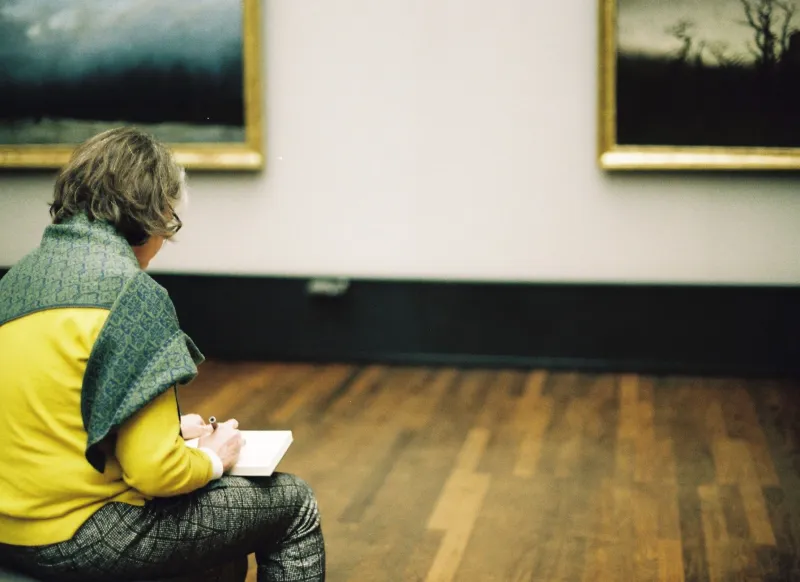
There is a particular kind of British Saturday that begins with grey light, a mug of tea and the vague sense that the day needs a destination. Not a shopping centre. Not another YouTube tutorial. Somewhere with radiators, benches and objects older than your oldest paint pot. A museum, then. Entry free, flask optional, pencil essential.
The best painting tuition is often not tuition at all. It is standing quietly in front of something real—a dented breastplate, a faded tapestry, a stuffed bittern—and asking how you would get that surface onto a 28mm figure. The answer rarely comes from a phone screen. It comes from slow looking, a stub of pencil and a note that says 'cold edge, warm rust, not silver'.
Why the pencil beats the camera
Phones are brilliant for recording what a thing looked like. They are less good at making you understand why it looks that way. A photo is instant and greedy; it takes everything and commits to nothing. A sketch, even a bad one, forces choices. You notice that the armour is not uniformly grey. You notice that the cloak folds in three directions, not one. You notice that the feathers on a taxidermy owl are a set of overlapping tiles, not a fuzzy texture.
So the rule for these visits is simple: pencil first, phone second. Make one rough drawing and five written notes before you take a single photo. Then take two photos—one overall, one detail—and put the phone away. You are not building an image library. You are building a painting vocabulary.
Five free collections worth the train fare
Royal Armouries, Leeds
Start with metal, because metal is where many painters plateau. The Royal Armouries has plate armour, mail, polearms and horse armour in abundance, and it is free to wander. The useful thing is not the shine. It is the evidence of use: rounded edges, patchy patina, oil-darkened joints, rivets that sit in little pools of grime.
Sketch a single pauldron rather than a whole knight. Note where the highlights sit and where the shadows collect. Ask yourself whether the steel reads cold or warm in that light, and write down the answer. Then look at the mail. Real mail is not a pattern of identical rings; it is a dense, slightly uneven mesh with darker gaps and brighter crowns. That note alone will improve your next armoured unit.
Victoria and Albert Museum, London
Cloth is the other great test of a miniature painter. The V&A is free and almost absurdly rich in textiles, costume and tapestry. Head for the galleries with cases of historic dress and look at cuffs, seams and hems. That is where the wear lives. A cloak does not fade evenly; it fades where it rubs against a belt or a wall. A banner does not hang in perfect folds; it sags and creases according to its weight.
Make a small diagram of three folds and label the light direction. Write down two colours you would use for the mid-tone and one for the shadow. If you paint banners or cloaks, this is more useful than another colour-wheel chart. The V&A also has metalwork and jewellery, so you can compare warm gold against cool silver in the same cabinet. That comparison is worth the trip on its own.
Natural History Museum, London
Feathers, fur, scales and beaks: the Natural History Museum is a free reference shelf for anyone painting beasts, familiars or mounted creatures. The temptation is to photograph a whole diorama. Resist it. Pick one bird and sketch the transition from breast to wing. Feathers overlap in rows, and the colour shifts because of the angle, not just the pigment. Note where the iridescence sits and where the feathers look dull and dusty.
Look at claws and beaks too. They are rarely one clean colour. There is a dark tip, a warmer base and a thin line of grime where the two meet. Write that down in plain language: 'tip near-black, base ochre, grime line at join'. That is a painting plan you can use on a plastic griffin in a fortnight.
National Museum of Scotland, Edinburgh
Edinburgh's National Museum has a generous spread of natural history, decorative art and technology, and it is free. It is a good place to study how different materials age in the same building: polished stone, painted wood, taxidermy, ceramics. For miniature painters, the value is in comparing textures side by side. A glossy ceramic glaze and a polished metal highlight are not the same kind of shine. A dusty taxidermy case and a varnished painting are not the same kind of dull.
Find a case with several objects and sketch a small grid of surface notes: shiny, dusty, chipped, soft. Then ask which of your paints you would reach for first. The answer might be 'none—I would change the brush'. That is a useful realisation. Texture is often a brush decision before it is a colour decision.
Pitt Rivers Museum, Oxford
The Pitt Rivers is free, densely packed and full of objects with real patina: weapons, tools, baskets, textiles and everyday items from around the world. For basing and weathering, it is hard to beat. Look at the undersides of things. Look at handles worn smooth in the middle. Look at how dust sits in woven textures and how cordage frays. These are the details that make a base look like a place rather than a plinth.
Sketch a small group of objects and note the colours of the shadows, not just the objects. If you paint rubble, gravel or jungle bases, this is your room. The museum's old cases and labels also offer a masterclass in muted, aged colour palettes—useful if your grey pile is starting to look a bit too clean.
A small kit and a simple method
You do not need an art degree. Take an A6 sketchbook, a 2B pencil, a rubber and a fine-liner. Add a single grey plastic figure in your pocket as a reminder of why you are there—not to wave about in the galleries, just to keep your eye honest. Check each museum's photography rules before you go, and book ahead if the website recommends it. Many free museums still ask you to reserve a slot, especially at weekends.
At each object, spend ten minutes on one drawing and five bullet points. Note three colours, two textures and one surprise. The surprise is the thing you did not expect: the blue in a black feather, the orange rust on a steel edge, the way a fold catches light from below. Those notes are the gold.
Turn the visit into paint
Go home, make tea and rewrite your notes while the memory is fresh. Stick the sketch near your painting desk. Next time you undercoat a figure, glance at it. You are not trying to copy a museum object onto a 28mm shoulder pad. You are trying to remember that real surfaces are uneven, directional and full of small decisions.
That is the quiet bargain of a free museum. You walk in with a grey plastic figure in your pocket and walk out with a head full of reference. The pencil does the teaching. The paint does the rest.